
A bridge builder’s quest
Rev. Vicki Garlock finds common ground and a world record by visiting the physical spaces of faith
By Chris Worthy
Rev. Vicki Garlock knows about faith. It’s personal, of course, but faith is also part of her vocation, her education, and her life’s work. As of last fall, she has the world record to prove it.
Garlock, who lives in North Carolina, is the award-winning author of “ABCs of the World’s Religions,” a beautiful book that teaches children about the rich diversity of faiths around the globe. Building that bridge between the world’s religious traditions has inspired Garlock across several practices, including developing non-devotional resources to support educators and families. (She has the academic cred for this too, including a doctorate in Psychology with dual specialties in neuroscience and cognitive development.)
But Garlock took on an unusual pursuit in September, overcoming disappointment and finding her own courage along the way.
An idea takes root
“In June of 2023, there was an article in Religion News Service about this guy in India,” she said. “He had established a world record for visiting the most places of worship in one month. And the record he established was 76. As soon as I read it, I looked up at my husband – sort of very ignorantly and very cavalierly, and I didn’t know what I was talking about – and I said, ‘Oh, I think I could beat that.’”
Garlock considered taking on the project in 2024, but really started researching in earnest in early 2025. She chose Chicago because she grew up about 60 miles south of the city and she knew it had a diverse faith community – plus it fit some of the other requirements she would need to meet to become an official Guinness World Record Holder. With a six-foot map on the wall, Garlock began mapping locations. All the while, she worked with Guinness to make an adjudicated attempt to break the record. Notably, the rules would require time-stamped selfies and videos and a signed witness verification at each stop.
“What I realized was that if I had to have someone sign a witness form in each place, I had to make sure somebody was there,” she said.
Going for a world record: two steps forward and one step back
August was spent sending emails and making appointments. By the end of the month, Garlock had 85 appointments set up for the month of September. She left a bit of margin for extra stops at the end of the month in case some fell through.
“I got to Chicago and I started Monday,” she said. “Sept. 1 was Labor Day, so there was no one around to sign my form. I was behind a day before I even started.”
Tuesday, Wednesday, Thursday – appointments were kept and forms were signed. So far, so good.
“On Friday, Sept. 5, at about 11:30 in the morning, I got an email from Guinness, and they said, ‘We’re sorry to tell you, but someone already broke that record, and the new record is 111.’”
To break the record, Garlock would now need to visit at least 112 places of worship.
“My initial inclination was just to freak out, but there wasn’t anything I could do,” she said. “On Friday, I went to my appointments. I had two appointments on Saturday morning and two appointments on Sunday morning. And I realized that was not going to cut it. I wasn’t able to go to two places and then sit in my Airbnb for the whole afternoon. So… Saturday, Saturday, Saturday, who was around on Saturday? Well, there were some Seventh Day Adventist churches that I had never heard back from. And I just thought, ‘I need to do something, and I need to be brave.’”
Going where the people are
Garlock showed up at the Seventh Day Adventist Church – it is an art gallery during the week – and she started explaining why she was there. Met with an enthusiastic response, her form was signed and she was told about other churches nearby and encouraged to visit them. She did, and found two places of worship in the same building, one with services in Spanish and the other in English. Each stop was met with more enthusiasm and more encouragement.
“I ended up getting six places that day, but it changed everything for me, because what I realized was that if I just showed up where people were, they would sign my form,” she said. “And that’s how I ended up getting 185 visits – just going where people are.”
Making room for serendipity in sacred spaces
“Originally, my idea was to lift up the diversity that we have in America, using Chicago as an example, and that still was one of my goals, but I ended up learning so much more,” Garlock said. “The most amazing part of the experience was all the connections I made. I went to 185 places for Guinness, and I visited over 200 places in total. I just met all kinds of people, all kinds of people. Every single place of worship has security nowadays, so I was just ringing the doorbell, and they were looking at me on their security camera and choosing to open the door to me. I would give my spiel, and in most cases, they would sign my form. I met a lot of administrative assistants. I met custodians, building managers, security guards, and cleaning people. I met all kinds of people who were associated with these spaces in some way, and in all cases, people are really connected to their space. They’re really connected to what that place and that space means to them.”
Visits were often as short as a few minutes, but sometimes Garlock was offered a tour.
“It was an incredible experience because, really, I was forced to do it in a different way than I had planned,” she said.
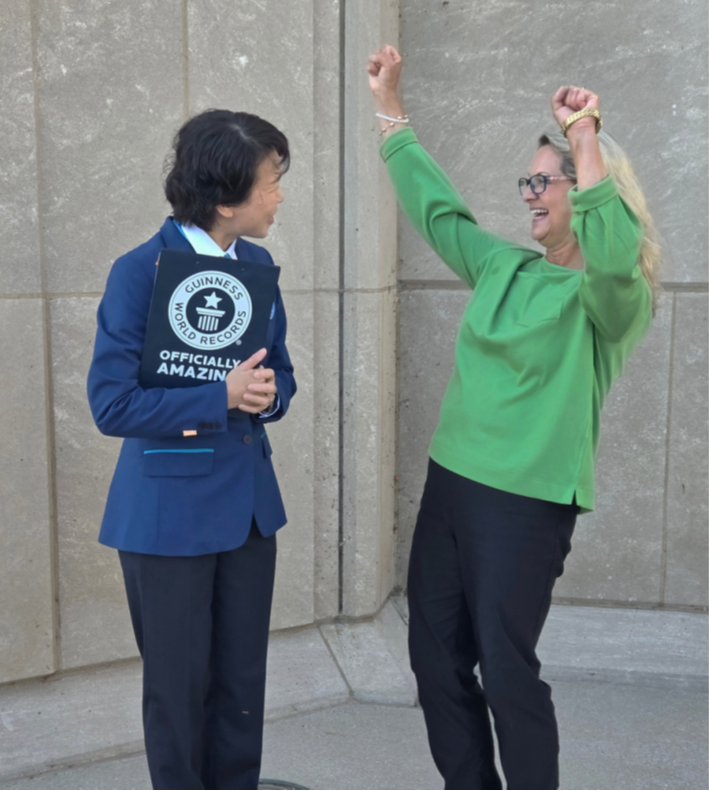
One of many special encounters
Garlock grew up well aware of the Great Chicago Fire that occurred in 1871.
“Many, many churches in the area were completely burned down, some within weeks or months after having been renovated. And yet, people figured out a way to keep going,” she said. “Several places I went to had one thing that survived the fire.”
One such encounter happened at the American Islamic College.
“I went there for Friday Jummah prayers – I was actually also able to go to over 20 rituals and worship services,” she said. “My contact there kept saying, ‘You need to go to the Chicago Buddhist temple. You need to go to the Chicago Buddhist temple.’ I had emailed and called and never heard anything back, but I noticed on their website that they had a social club meeting on Saturday.”
Following her own direction to “go where people are,” Garlock showed up.
Giving her elevator pitch about the world record attempt, Garlock was invited in and checked off the Guinness requirements. Then, the minister invited her to a separate room that held a wooden altar.
“She said, ‘This is an altar that was built of scraps that people found when they were in the (World War II) internment camps.’ Japanese Buddhists in the internment camps took whatever materials they could find, and they built an altar for themselves so they could maintain their worship.”
The altar is more than an artifact. It is a tangible reminder of faith and resilience.
“It affirmed the idea of how people maintain their practice, maintain their worship, across history and across changing demographics and changing historical circumstances,” Garlock said.
A lesson to carry forward: resilient faith starts with community
“Visiting places of worship is really interesting because we read a lot about how people don’t attend worship services anymore,” Garlock said. “We read a lot about Christianity, because Christianity is so pervasive in the US, but this is true across religious traditions. Jews will tell you young people don’t go to synagogue, and Buddhists will tell you young people don’t go to temple. One of the things that was so cool about this was how creative and resilient faith communities are and how resilient and creative places of worship are. What you see is these massive churches – huge churches that are way, way bigger than any single congregation needs – so you see a lot of sharing space.”
Among many examples Garlock saw, it means a Christian church shares space with a synagogue and a Buddhist temple is in the same building as a Unitarian church.
“These are places that, in theory, do not have the same theology at all – and yet they can share physical space, and they do so well, and they do so with pride,” she said. “The resilience is amazing.”
Teach your children or your classroom:
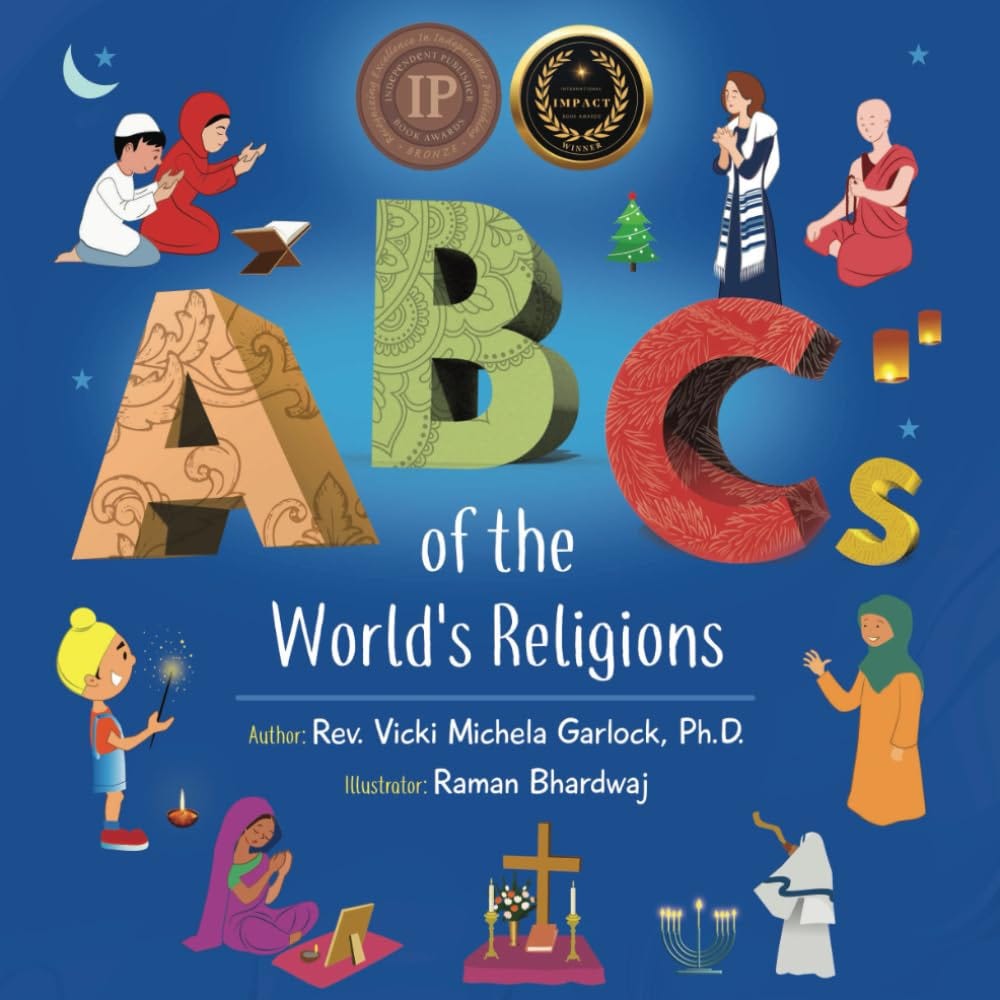
Rev. Vicki Garlock created resources to help families and educators teach children ages 3 – 12 about the world’s religions. Learn more at worldreligions4kids.com and follow her on Instagram at worldreligions4kids.
Garlock is the author of several books for children and families. Learn more and buy at worldreligions4kids.com/childrens-books.
· ABCs of the World’s Religions
· We All Have Sacred Spaces
· Embracing Peace: Stories From The World’s Faith Traditions
· Interfaith Peace Curriculum – available for four age groups from preschool through middle school.
Thanks so much for sharing my story!