
By Chris Worthy
Poets gather past, present, and future, sifting the chaff and knitting the throughlines into something that is transcendent. Glenis Redmond is an accomplished poet, teacher, and community voice, a renowned scholar and author, a daughter, mother and grandmother. She is also Greenville, South Carolina’s first poet laureate, the holder of songs and faith and stories both personal and collective. When she gives them back in verse, we are lucky indeed.
The heart and soul of a poet can weave history, pride, and legacy into a tapestry that survives. For Redmond, whose motto is “bloom anyhow,” her ongoing project to document Rosenwald Schools, specifically the one that served her parents, is personal, yes, but it is much more.
Each story, each image and document is another line in the volume that she is uncovering and preserving for the generations to come. At least in this case, history has found its champion and it will not be denied. For that, the world owes Redmond a debt of gratitude.
“I knew they were from South Carolina,” she said of her parents. “I did not know the struggle it was for my mother to actually get to a school because she lived in Laurens, and there was no school for quote, unquote ‘colored’ kids.”
To give her that opportunity, Redmond’s grandmother made a profoundly important decision: she sent her daughter to live with an aunt and uncle in the small town of Fountain Inn, where a Rosenwald school could change her life. Its impact ripples even now.
A preeminent education
Julius Rosenwald and Booker T. Washington led the initiative to build schools that brought not just formal schooling but preeminent education to Black children in the segregated South. According to the National Trust for Historic Preservation, more than 5,000 of these schools were built in the early 1900s, serving a third of Black children and teachers in the rural South. It is impossible to overstate their importance to individuals, families, and communities. The list of graduates is a who’s who of American history, including such icons as John Lewis and Maya Angelou. Yet following desegregation, many were torn down or not preserved, with only about 10% remaining. The schools are on the Trust’s list of Most Endangered Historic Places.
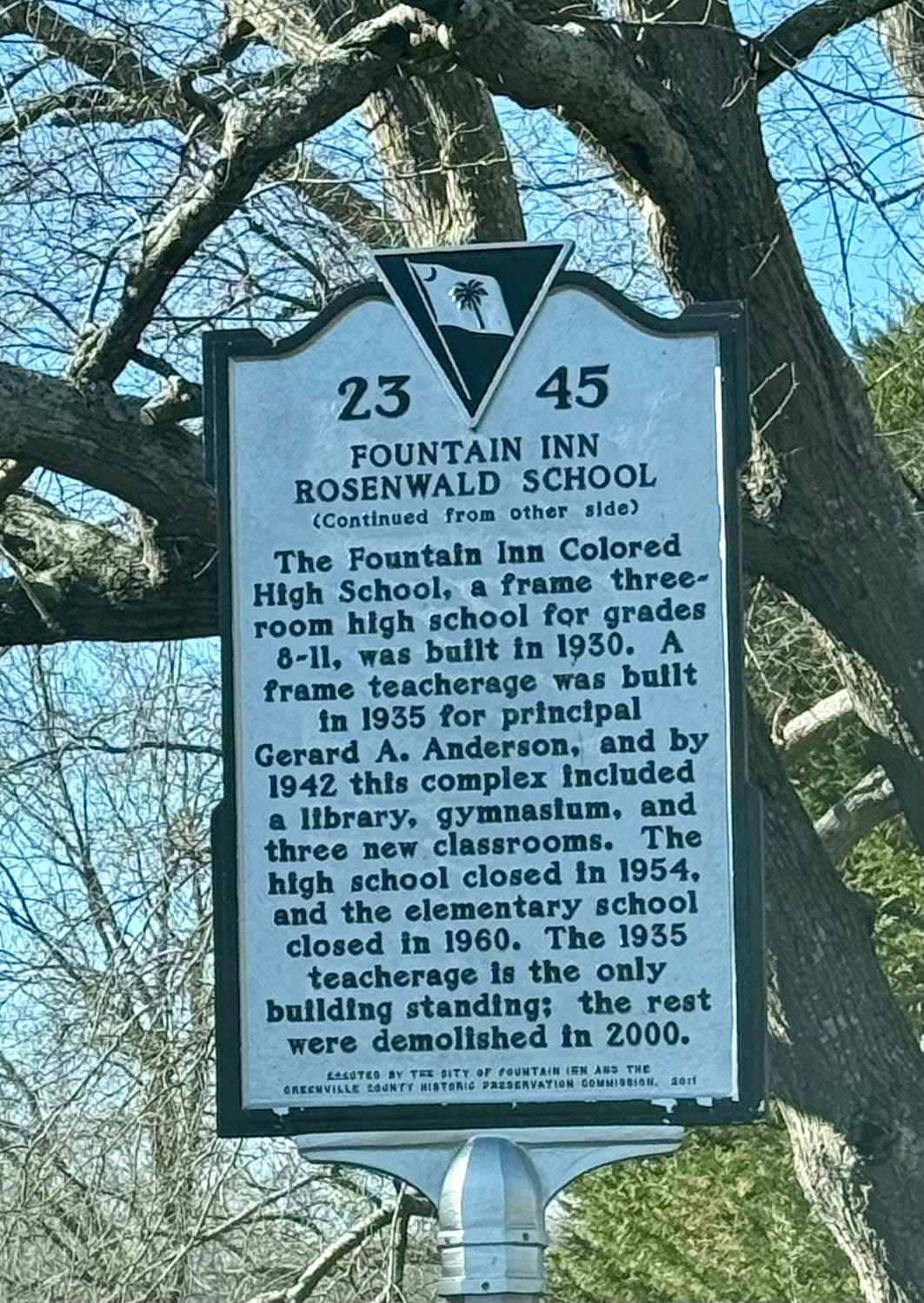
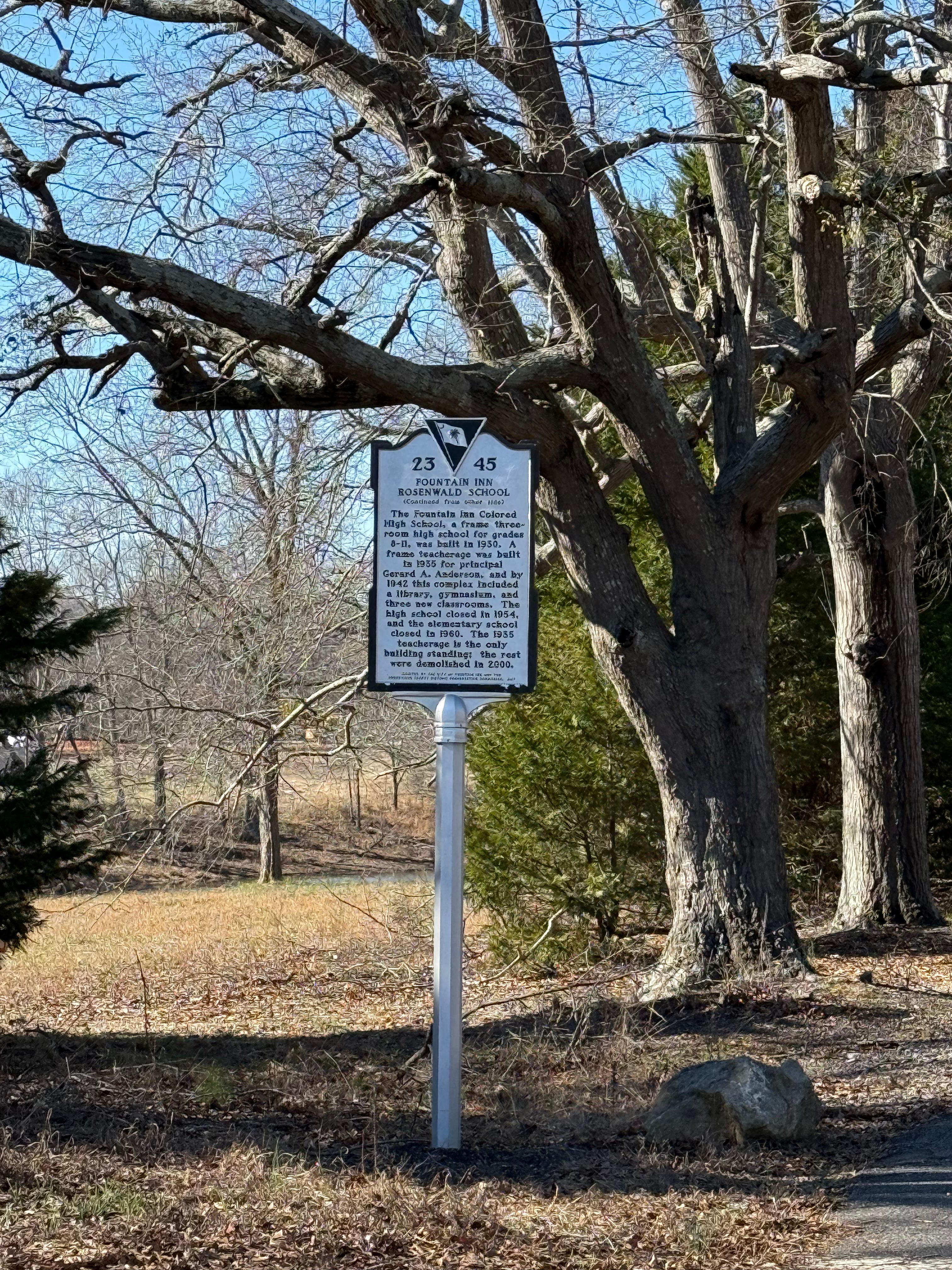
The school that Redmond’s parents attended was demolished. Only the teacherage building remains.
“My mother thought she was being given away. She really felt she was being given away. But her mother, who had a third grade education, was actually giving my mother something that she never had, and that was a high school diploma. My mother graduated from high school – and I didn’t realize it, she was the first of her family to graduate from high school,” Redmond said.
It is rare and extraordinary to look at one choice in a family’s chronology and see its impact. This is one of those times. And around family dinner tables and in tears and struggles across countless other families, the path to education was created step after step, in the face of racism and the systems designed to uphold it. Rosenwald Schools are a triumph to be celebrated and honored.
“I knew my parents went to high school. I saw their picture. I saw my mother’s graduation picture. I saw their prom picture, but I didn’t know what was behind that until I started digging and writing about place,” Redmond said. “When I moved back about 13 years ago, I got really curious, and all of this came up, but I had learned about Rosenwald schools because I’m a teaching artist. Traveling across the country, traveling across North Carolina, South Carolina, I would see these markers, and I would see these one-room school houses, and I would see ‘Rosenwald.’ I knew they were for the Black community, but I did not know my parents went to a Rosenwald.”
“Oh my goodness”
Redmond’s mother, at just 11 years old, was being groomed to be a maid by the white woman Redmond’s grandmother cleaned for – a system upheld in practice over generations throughout the South. Education offered options.
As Redmond began to learn her family’s story, she saw the parts come together.
“I was like, oh my goodness, one piece belongs to the other, and then it’s a work of really trying to figure out who I am. It was about identity and who my family is, and who our community is, and the strides that it took, and this one single act of her mother saying…‘I’m not going to have it.’”
For a woman who paints with words, this epiphany launched the creation of a new portrait.
“In the whole lineage, literacy is very tenuous. But to see my grandmother saying, I know there’s more…,” Redmond said. “My grandmother was doing these invisible lifting acts, not just for herself, but for the community. So, I think she might have been sad to send her child away, but she knew it was for a greater good. And then eventually my mother turned around and saw exactly what her mother was doing for her, because she met my dad. He went in the Air Force that took her away and lifted her out of abject poverty.
So, there were just these pivotal moments that happened, and I see my grandmother as the person in there doing this heavy lifting. It’s quite astounding, but it’s also so lovely in a way. I wouldn’t be sitting here if my grandmother had not done that, I would not be a poet if my grandmother had not done that.”
A history to come
The Rosenwald story is Redmond’s to tell, and what a story it promises to be. She is turning this legacy project into a book. There will be poetry, of course, as well as history and biographies. She is filling in the blanks with extensive research and personal stories, already chronicling the teachers – “they were fierce, and they were fearless” – who came from South Carolina’s Lowcountry to teach in the Upstate, loved and nurtured their students and held them to exacting standards of excellence, which allowed them to soar. But she is on a deadline, of sorts, gathering and saving it all in a race against the clock, and she is also writing a middle grade book about “Peg Leg” Bates, perhaps the most famous student from the school in Fountain Inn.
“Time is of the essence, because these people are in their 80s and their 90s, so I’m trying to do as much as I possibly can,” she said. “It’s about the people who went there, but it’s also about the place. It’s about the people who are no longer living, the principal and his wife, the buildings, the land, everything. It will be a way to preserve what’s kind of been pushed aside, and restore as much as I can. What I can’t do with brick and mortar, I will do with words and metaphor.”
And Redmond’s ancestors provide the spark that keeps her going.
“I’m fortunate to have the tool of poetry and a strong sense of faith that allows me to be able to hold all these worlds,” she said. “There are days where it’s daunting, it takes faith… You find your purpose, and you go and do your work. And mine happens to be sewing, but not in the same vein as my mother, my grandmother, and my great grandmother. Mine is to take this memory, the fabric that they’re handing me – I just feel like they’re feeding it to me – and I just keep making these poems. I keep making these dress poems to live in the world and to be able to face the world. It’s almost like it’s an armor, like it’s a way to move in the world. They are my cloth. They are my material. They are my everything. They’ve allowed me to continue, to be an extension of that.”
Be a part of the story:
· Support this work by supporting its creator. Buy Redmond’s books and learn about her teaching and speaking at glenisredmond.com.
· Subscribe to Redmond’s Substack.
· If you have Rosenwald stories or some of the precious limited photos to share, contact Redmond through her website.
· Support the African American Cultural Heritage Action Fund to help save historic places, including Rosenwald Schools.
· Read more about the Fountain Inn Rosenwald School here.
Additional sources: