
To the moon (again)
A conversation with moonwalker Gen. Charles Duke
I interviewed Gen. Charles Duke in 2018, and this piece ran in three parts last summer on my personal Substack. As Artemis prepares to launch, I have a lot of complicated feelings about it as a lifelong space nerd, but one thing remains true: We need reminders that we live together on a tiny blue dot in an incomprehensibly vast universe.
By Chris Worthy
The gray powder at his feet showed no signs of life. There were no green shoots, no pregnant seeds pushing their way up through the ground. Even after the most devastating forest fires, there are remnants of tender rings under charred bark, and almost overnight, the promise of new growth.
But in the desolation around him, there was none of that. A scan of the landscape revealed cold, rocky, sterile ground. But follow that view to the horizon and there it was. Hung against a deep, black sky, home is forever blue, brown, green, and white.
Brigadier General Charles Duke is a man of science and faith, someone who possesses a self-awareness that is as deep as his intense love of people. He has experienced life on the edge in a way that few humans ever will. As one of the four living Americans who walked on the moon, he has found that life down here on Earth can be pretty remarkable, too.
I was born at the end of the space race, was glued to Star Trek reruns as a kid, and moved nearly to tears the first time I saw a space shuttle in person. (The charred heat tiles did me in.) I hope I never stop feeling that lump in my throat and goosebumps on my skin when I see humankind slipping the bonds of Earth.
Charlie Duke grew up just up the road from my hometown in South Carolina. We cheer for the same college football team. He holds honorary degrees from my small, undergraduate alma mater and the flagship university where I earned my law degree. The way I figured, we were connected, whether he knew it or not.
He responded to my interview request in 2018 with a brief and simple invitation to call him. Well, sure, I could do that. When he answered the phone from his home in Texas, I learned that, as it turns out, he feels as strongly about awe as I do. Moon walks can change a person. And for Duke, faith proved to be an even greater catalyst to new life.
Finding awe
“There were several times in my life – more than several – when I’ve experienced what I would call awe, the overwhelming feeling of beauty and wonder, those kinds of emotions,” he said.
Not surprisingly, many of those experiences came during his time with NASA. Following his graduation from the Naval Academy in 1957, Duke became a fighter pilot and later a test pilot with the U.S. Air Force. In 1966, he was selected to be part of the Apollo program that would take humankind to the moon. In all, Duke served on five Apollo missions. He was CAPCOM on Apollo 11, and it is his voice, in that familiar-to-me Southern accent, that, following the lunar module’s landing, declared “You got a bunch of guys about to turn blue. We’re breathing again.”
Duke was a backup crew member for the Apollo 13 mission, when the now famous, “Houston, we have a problem” was uttered, but exposure to rubella ensured that he was grounded for that flight.
By 1972, the country was entrenched in war and just months away from being rocked by a presidential scandal. And Charlie Duke was finally set to blast off on Apollo 16 as lunar module pilot.
But his first experience of awe in the space program came years before that first step on the moon, back when Duke was still decidedly earthbound and anxious to break free. It was engineering, not astronomy, which made an indelible impression. A hunk of metal and electronics took his breath away. I could almost hear him smiling as he talked about it.
“I was standing about three miles away from the liftoff of the Saturn V, which is the rocket I was going to ride to the moon,” he said. “It was so impressive – the vibration of the atmosphere and the ground and the noise. As you viewed this machine – enormous machine – lifting off and flying so perfectly up the side of the launch tower, it was just an awesome experience. I was so excited that one day I would get the chance to ride that.”
A big ride out of here
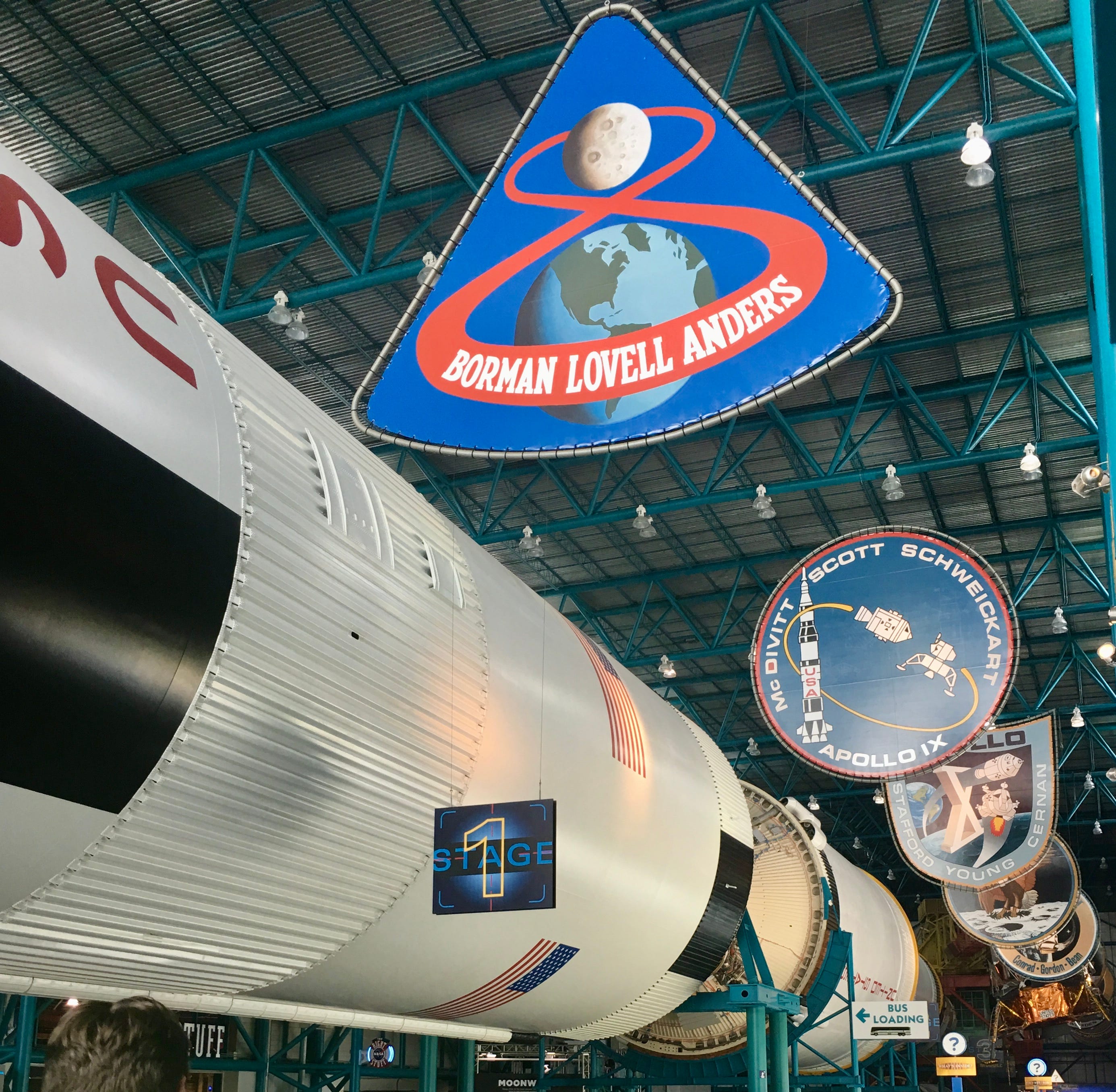
The Saturn V is truly an engineering feat of galactic proportions. At 363 feet long and the weight of 10 school buses, the scale is astounding. Visitors to Kennedy Space Center can stand under one as it hangs horizontally on display. To do so is to be dwarfed by every part. Decades after it first propelled America’s role in the space race, it is still the largest and most powerful U.S. expendable launch vehicle ever built.
“Once we got to working on the flight, to go out to the launch pad and stand at the base of that rocket and look at the size, to think this thing is the biggest rocket ever built and it’s going to take us to the moon. You are basically just overwhelmed with that sense of the ability of the engineers and technicians to build something like that and to engineer it in such a way that it all works. It takes a lot to do that. I was so thankful that so many talented people worked on it. The success of that rocket was, I think, probably one of the best ever. People see it on TV and they see it from a distance, but you really can’t appreciate the size of it until you, like you did, stand in the Apollo Saturn Visitors Center at Kennedy Space Center or a similar one in Huntsville, Alabama. You get the sense of the enormity of this rocket.”
Duke said the five engines of the first stage “are staring you in the face.” The potential power, even when dormant, is almost more than a relatively tiny human can process.
“I remember one time, I was out on the launch pad for something. I was walking around and got one of these guys to take me up to the level where these engines were. There was a work platform under there and I got on that and stood up inside one of those nozzles on the engine bell and stretched out my arms and I touched the sides,” Duke said.
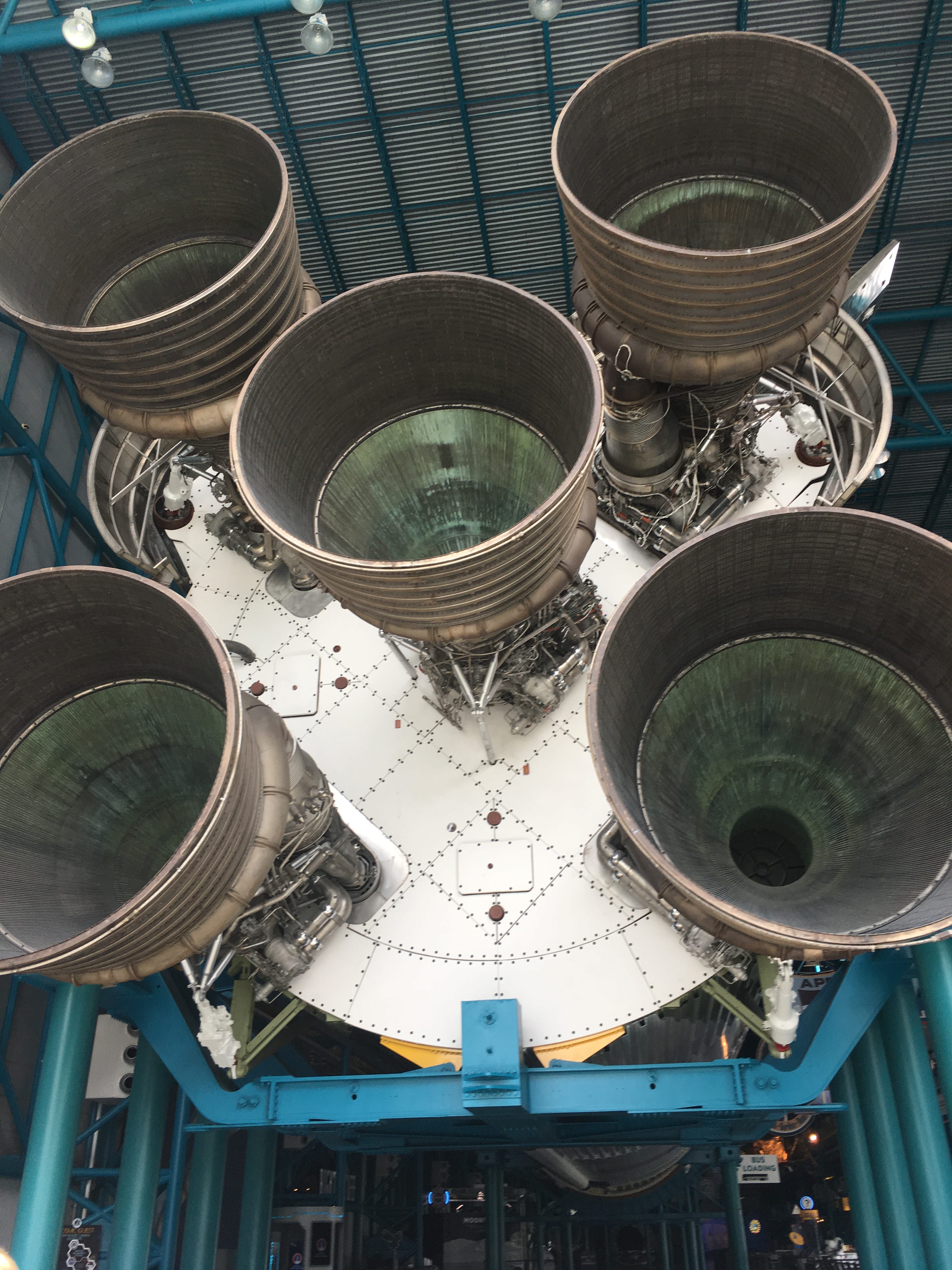
For Duke, that marvel of humans’ intellect and engineering was more than a source of awe. It was his ride out of here. He and his fellow astronauts, Commander John Young and Command Module Pilot Thomas K. Mattingly II, launched from Kennedy Space Center at 12:54 p.m. on April 16, 1972.
Between two worlds
It seems fitting that Charlie Duke left the planet from a spot that is saturated with the rich greens and vibrant blues of Florida’s Space Coast. Land and water reach toward each other like fingers in an area that teems with life. White egrets nest on the site and its resident prehistoric throwbacks – giant American alligators – can rival the rumbles of engines in their full-throated hisses and roars. These days, visitors can ride a tame, air-conditioned tour bus past the oversized Vehicle Assembly Building, alongside the crawler track, and near the launch pads. If your timing is perfect, the weather smiles upon you, and an endless number of other factors big and small fall into place, you can be lucky enough to see a new generation of vehicles launch with the same fury and glory of the early days of space travel, though now the computers are a lot smaller, the spacesuits are sleek, and the video has moved from grainy black and white to full high definition that makes you feel like you are along for the ride.
In stark contrast to that lush Florida landscape, a primary part of the Apollo 16 mission was to survey and collect samples from the moon’s hilly Descartes landing site. It is almost inconceivable to me that humans can overcome the relative security of our home planet and just leave it. They venture off-world like a character in a Ray Bradbury story. It seems beyond the capacity not of our engineering prowess or collective brain power, but our primal instinct to survive. I learned in conversation with Duke that perspective really is everything. He told me that fear was kept at bay by training, training, training, and then, training some more. Study, work, and preparation from college to flight school to the deserts of the American Southwest meant that Duke and Young, the pair who would work on the moon’s surface, were ready to explore new territory. Duke knew what to do and how to do it, and he had teammates stationed on two worlds who were equally creative, confident, and qualified. Apollo astronauts honed their lunar geological skills with the closest facsimile they could get on their home planet. They trained in rugged desert terrain. It was still a far cry from operating off-planet, but it was a means to a remarkable end.
Time to go
Though there were some glitches on the mission, liftoff of Apollo 16 was textbook perfect, if not a gravity-defying assault on the blood and tissue bodies of those riding the power of the Saturn V through the atmosphere. Oh, but that view. It made all the hard work and the rollercoaster of emotions well worth it.
“The first time I really had a sense of awe in that mission was when we left Earth orbit and we turned our spaceship around. Looking out the window, the Earth came into view and we were about 20,000 miles away, and you could see the whole circle of the Earth. It was awe. It was breathtakingly beautiful to see the whole circle of the Earth just suspended there in the blackness of space. That awe that I had was really one of the deepest feelings I’d ever had of the beauty of the Earth – the blues and the whites and the clouds and the snow, the brown of the land. That jewel of the Earth was suspended in the blackness of space. It was just incredible.”
Can we share it even if we can’t see it? Hearing Duke’s nearly breathless sense of awe in recounting the memory of that overview of our planet makes me believe that we can. He passed it to me with the ease of someone sharing a segment from the juiciest orange. When we spoke nearly 50 years after the launch, he was effervescent about both the details and the grand philosophy of such an experience, and now I have a bit of it to carry with me, too.
Outside of time
“When you’re going to the moon, Apollo is a three-day trip but it’s always daylight. There’s no night in space. The sun is always shining, so you make your night by putting up curtains in the spacecraft and turning off the lights. You think about a trip to Mars, which could be six or seven months. They’re always in sunlight. You regulate your Circadian rhythm by lights and shades and the counts. In Apollo, we had a clock that started at liftoff and just kept counting – one hour, two hours, three hours, four hours – and your flight plan was based on that clock. We went to the moon at three hours-and-something, three or four, and at 15 or 16 hours was the first sleep period, so we put up our curtains and said good night to mission control and turned out the lights. You’re still so excited at that point that you don’t get much sleep, at least I didn’t. The other two guys did pretty good. It’s hard to get my mind in idle so you can drift off to sleep.”
Duke sees his voyage and his remarkable 21 hours and 38 minutes on the moon’s surface through the lens of a man of deep faith. He still speaks of it all as if it happened yesterday, but with the deepened sense of purpose that comes with reflection and sharing his stories with many. He said entering lunar orbit brought a new moment of awe.
“On the backside of the moon, it was dark in that area of the moon when we entered orbit. A few minutes later, we came into sunlight. That was a very awesome experience – and dramatic. As you look down on that part of the moon you can’t see from earth, as the sun rose, we were going around in orbit and the shadows got less and less, but it was very dramatic and an awesome feeling to look down and see the roughness and the hills. You couldn’t see individual rocks, but you saw piles of rocks from the center of some of those craters. It was a feeling of, as Buzz Aldrin said, ‘magnificent desolation.’
Then we came around the front side and saw Earthrise for the time, and it was Earth just suspended out there in the blackness of space. The awesome feeling I had of the beauty of it and thinking about the distance that we had traveled, and there it was: our island home, 240,000 miles or so away. One of my first thoughts was, ‘We’re a long way from home. I hope this thing works.’”
Seeing with new eyes
Duke experienced the Overview Effect, a term coined by space philosopher Frank White. It describes the profound shift in perspective experienced by those who view the Earth from space. Looking down on this fragile blue marble that houses all known life in the universe can, and arguably should, change a person forever. The planet seems more delicate and its inhabitants more alike than different. We are each and all together just a dot on the fabric of space. It seems a heady concept, but sit with it for a moment and that fresh look at ourselves and the whole of human life can turn Duke’s stories of space into a secondhand view that guides our appreciation for the powerful experiences available to us right here on the ground. His delight can become our gateway to a look at the world anew.
“As we orbited the moon, I was able to hold my hand out and cover the Earth. You don’t see any countries or continents or nations, if you will – no borders, is what I’m trying to say. It’s even hard to describe the land you’re seeing. It’s mostly clouds and oceans. You’re seeing dots of brown down there so you have to ask Houston what you’re looking at, as far as the land goes. A lot of us came back and said the Earth is fragile and we’re all down here on Spaceship Earth, as some people have described it, and we all share the same resources, so we’ve got to learn to get along with one another. I think it helped birth the environmental movement in a way. I kept saying for four or five years after my flight, ‘You know, we’ve got to learn to get along and love one another.’”
On the surface of the moon with the black velvet of space just beyond, Duke says the feeling was so difficult to assimilate that it was nearly euphoric. It is easy to feel that he gulped in the sights and emotions, filling himself with as much of it as possible and creating a storehouse that he draws from even long after retirement.
“As I stood on the moon, I had a few minutes to reflect. This sense of awe and wonder again – here I am standing on the moon and the Earth is over my head, 240,000 miles away, and it was the most beautiful desert that I had ever seen. The overwhelming thought was that nobody has ever been here before. John and I are seeing this for the very first time up close, and the stark break between the bright lunar surface, and above that, the blackness of the sky, was breathtakingly beautiful.
There were a number of these moments where we experienced this sense of awe and wonder. Awe and wonder to me are synonyms. There was a movie done documenting our feelings. It was called ‘The Wonder of It All.’ The title of that movie came from my interview where I said, here I was standing and I was just overwhelmed with the wonder of it all – the beauty and the excitement and the adventure and the sense of longing, if you will. It’s just an incredible feeling for me. It’s hard to describe really what you’re feeling. I guess that’s what awe does to you. You wonder.”
Carrying the feeling
That wonder hasn’t diminished for him. In fact, Duke has spent much of his life since retirement sharing his Christian faith, which was only reinforced by his experiences on another world. Perhaps it made the fragile beauty of home more critical to him, too.
“There have been spots on Earth where we’ve experienced the same feeling of awe and grandeur, like the Grand Canyon, the mountains in the South Island of New Zealand, and hiking through the Alps – all bring a sense of awe and wonder to me as you experience the beauty of nature and the beauty of the creation God has given us.”
In this new era of commercial space travel, there is perhaps less risk (or least less sense of it for those of us on the ground), definitely a condensed form of training, and a mind-boggling price tag for those not fortunate enough to otherwise snag a seat. For the minutes-long, atmosphere-breaking flights that have taken influencers and the wealthiest of the wealthy – and even an officer from my beloved Star Trek – to view what so few have seen, their returns are always punctuated by that same breathless urgency to make sense of what they have witnessed. Whether they have minutes or days or months in space may shape an astronaut’s ability to understand their awe and convey it to us, but maybe that doesn’t matter. I don’t know if that near drowning in awe will inspire them to save the world, but I hold out a bit of hope for that, even still. To go boldly, and to tell and hear the tale, is to be changed.